
The Solicitors Regulation Authority (SRA) sets the rules that all solicitors and law firms in England and Wales must follow. These rules exist to ensure that anyone using legal services is treated fairly, safely, and professionally
News & Clients Say

Pressure Sores and Medical Negligence: What You Need to Know
Pressure sores, also known as bedsores or pressure ulcers, are a serious health issue that can have devastating consequences for patients. They don’t just cause physical pain, they can also be a sign of medical negligence when preventable harm occurs in hospitals, care homes, or other healthcare settings.
The financial and human cost
Between the financial years 2013/14 and 2023/24, clinical negligence claims involving pressure sores cost the NHS a staggering £107,476,137 in compensation. This includes claims resolved through standard settlements and periodical payment orders (PPOs).
Even in the most recent 2024/25 financial year, the problem persisted. Compensation payments for claims involving pressure sores reached £14,030,385, highlighting both the financial strain on the healthcare system and the severe impact on patient’s lives.
What are pressure sores?
Pressure sores develop when prolonged pressure restricts blood flow to the skin, often causing tissue damage. They usually affect patients who are immobile or otherwise vulnerable.
These sores are graded by severity:
- Grade 1: Mild skin discolouration
- Grade 2: Damage to the top layers of skin
- Grade 3: Deep wounds affecting the underlying tissue
- Grade 4: Severe wounds reaching muscle and bone
While anyone can develop a pressure sore, certain patients are at higher risk.
Who is most at risk?
People who are confined to bed, sitting in a chair, or in a wheelchair for long periods are particularly vulnerable. Those at higher risk include:
- Elderly patients
- Individuals with urinary or bowel incontinence
- People with paralysis or limited mobility
- Patients recovering from illness, trauma, or surgery
- Individuals with medical conditions affecting blood flow or skin integrity
When are pressure sores a sign of negligence?
Healthcare providers have a legal duty of care to prevent avoidable harm, including pressure sores. Negligence may occur if:
- Risk assessments for pressure sores are not conducted or regularly reviewed
- Patients are not repositioned regularly to relieve pressure
- Suitable equipment, such as pressure-relieving mattresses or cushions, is not provided
Failure to meet these standards can lead to serious complications, including infections, long-term pain, reduced mobility, extended hospital stays, and, in extreme cases, death.
Studies suggest that 80-95% of pressure sores are preventable with proper care, highlighting how many of these injuries could be avoided entirely.
Additional complications
As a pressure sore progresses, the risk of serious complications rises significantly. What may begin as a small area of redness or skin breakdown can quickly develop into an open wound, creating a direct pathway for bacteria to enter the body. Infection is the most common complication. While it may start as a localised wound infection, without prompt and appropriate treatment it can spread to surrounding tissue and beyond.
If the infection enters the bloodstream, the consequences can become life-threatening. One of the most severe complications is sepsis. A condition in which the body’s response to infection triggers widespread inflammation. This overwhelming immune reaction can impair blood flow, damage vital organs, and, in severe cases, lead to organ failure. When bacteria from a pressure ulcer spreads systemically, the situation can deteriorate rapidly and requires urgent medical intervention.
In advanced stages, prolonged and unrelieved pressure can deprive tissues of oxygen and essential nutrients. Without adequate blood supply, the affected tissue begins to die – a process known as necrosis. Necrotic tissue cannot heal and significantly increases the risk of deep infection.
When a pressure sore progresses to Stage 4, the damage extends beyond the skin into muscle and even bone. At this stage, bacteria can invade the underlying bone, resulting in osteomyelitis, a serious and difficult to treat bone infection that often requires long term antibiotics and sometimes surgical management.
Protecting a patient’s rights
If you or a loved one has suffered from pressure sores due to inadequate care, it’s important to know that help is available. Our medical negligence team can help you to secure compensation for the pain, suffering, and additional care needs caused by preventable injuries.
Our expert team will assess if you are eligible to make a claim and guide you through the process, helping you understand your options and fight for the care and support you deserve.
Resources
https://resolution.nhs.uk/wp-content/uploads/2025/12/FOI_7550_Claims-for-bedsores-and-amputation.pdf
https://resolution.nhs.uk/wp-content/uploads/2025/05/FOI_7183_Pressure-Sores.pdf

We want to extend a massive thank you to our wonderful colleagues, Kirsty Cartwright and Hannah Vaughan, for dedicating their time and expertise to attend the annual Careers Fair at Blue Coat School Liverpool last Friday

March 3 /
Community, News
Maxwell Hodge Solicitors reinforces their dedication to supporting local causes by donating £1,800 to ‘Aid to All’ Charity
Dan Eales, Manager at Huyton branch of Maxwell Hodge recently visited ‘Aid To All’, a registered charity based in Huyton, to present a donation of £1,800.00. The donation will make a significant impact on the local community.
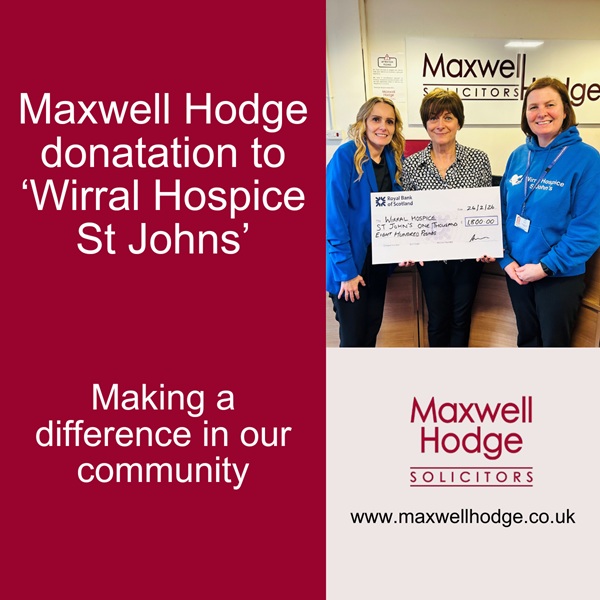
Julia Evans, Giving Manager at Wirral Hospice St John’s recently visited our West Kirby branch, where Candice Jones and Lisa Cockburn proudly presented a cheque for £1,800 on behalf of the Directors at Maxwell Hodge.

Buying a home is one of the most significant financial decisions a person can make. If you own a leasehold house, you may not realise that you have the opportunity to purchase the freehold, or you may wonder whether it would be worthwhile.

The theme for this Children’s Mental Health Week is ‘This is My Place’ aimed at helping children and young people feel that they belong.

Our next SIMPLY CASTLE STREET is now live on Eventbrite – Friday 13th February, 10:30am-12 noon at San Carlo, Castle Street, Liverpool

We received a range of feedback from clients from our end of matter questionnaires. We also have online reviews from clients on Review Solicitors, achieving a current excellent rating of 4.7 out of 5

We are delighted to announce that Hannah Vaughan has commenced her training contract.
Hannah joined Maxwell Hodge in January 2024 as a Conveyancing Assistant and is now embarking on the next exciting stage of her career as a Trainee Solicitor