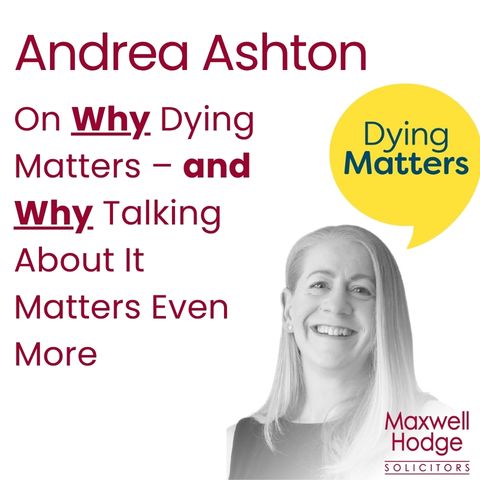
This week (4–10 May 2026) marks Dying Matters Awareness Week, a national campaign led by Hospice UK, encouraging us all to have one of life’s most important—yet often avoided—conversations: death, dying, and bereavement.
This year’s theme, “Let’s Talk About Death and Dying,” is simple in its wording, but powerful in its intent.
Because for many people, this remains the conversation that never happens—until it is too late.
The Silence Around Death
Despite the certainty of death, our discomfort with discussing it remains striking.
- Around 27% of people find it difficult to talk about death with family or friends. [hospiceuk.org]
- 30% say they bottle up their feelings instead of speaking openly. [hospiceuk.org]
This silence is not without consequence. When conversations don’t happen:
- Wishes can go unknown
- Decisions fall to others unexpectedly
- Families face additional stress at already difficult times
In my professional world—working closely with clients on lifetime and estate planning—I see this first hand. The absence of conversation often leads not just to practical complications, but to emotional ones too.
Why These Conversations Matter
Talking about death is not about being pessimistic. It is about being prepared.
It is about giving yourself—and your loved ones—clarity, control, and peace of mind.
Research consistently shows that people value autonomy, dignity, and quality of life at the end of life, yet there is often a gap between intention and action when it comes to planning.
Open conversations can help bridge that gap.
They allow us to:
- Express preferences around care, treatment, and final wishes.
- Reduce uncertainty and anxiety for family members.
- Make informed legal and financial arrangements.
- Ensure that the decisions made reflect what truly matters to us.
Ultimately, these are not just conversations about death. They are conversations about how we want to live until the very end.
Planning Is an Act of Kindness
In private client practice, we often talk about wills, lasting powers of attorney, and estate planning as legal necessities.
But in reality, they are something more human:
They are acts of care.
When someone has taken the time to consider and communicate their wishes, it removes a significant burden from those left behind. It allows families to focus on what matters—supporting each other—rather than navigating uncertainty.
Starting the conversation can bring comfort, clarity, and connection when it matters most.
The Role of Professionals
As advisers, we are often in a privileged position.
Clients trust us not only with their assets, but with their concerns about the future—concerns that frequently go far beyond the legal or financial.
Dying Matters Week is a reminder that our role goes deeper than technical advice.
It is about:
- Creating space for sensitive conversations.
- Using clear, compassionate language.
- Helping clients articulate their wishes with confidence.
- Guiding families through both planning and difficult moments.
These discussions are not always easy—but they are always important.
Starting the Conversation
One of the biggest barriers is simply knowing where to begin.
The truth is: there is no perfect moment, and no perfect wording.
It can be as simple as:
“I’ve been thinking about this recently…”
Or using something like Dying Matters Week itself as the catalyst.
What matters is not how eloquent the conversation is— but that it happens at all.
A Collective Responsibility
Death, dying and bereavement will touch every one of us.
Yet as a society, we are still learning how to talk about it.
Dying Matters Awareness Week is not just a campaign. It is a call to action—to normalise these conversations in our homes, workplaces, and communities.
Because when we talk more openly:
- People feel less alone.
- Decisions become clearer.
- Experiences at the end of life can be more aligned with personal wishes.
Final Thoughts
If there is one message to take from this week, it is this:
Talking about death does not bring it closer—but it can make all the difference when it arrives.
Whether as individuals, families, or professionals, we all have a role to play in changing the narrative.
Let’s start the conversation.
As someone working in private client matters, I welcome these conversations—and encourage clients to approach them not with fear, but with confidence and care. Contact me or a member of our Lifetime Planning Team for advice, support, and guidance:
- Jennifer Monaghan (Aintree and Kirkby)
- Ciara Furey (Formby)
- Kirsty Cartwright (Huyton)
- Hannah Alexander (Maghull)
- Andrea Ashton (Wirral and Woolton)
- Candice Jones (Wirral)